|
Volume 01 · № 02 · July 1, 2026 |
|
The
Throughline
|
from CIOPages
|
An Independent Briefing for Technology Leaders |
This issue: the spreadsheet that decides for you. We look at how weighted scorecards manufacture confidence — and why the bravest move in the room is to own the call yourself. |
The Big Read · the feature
Why Weighted Decision Matrices Produce False Precision
Score the vendors, weight the criteria, and the matrix hands you an answer to two decimal places. But the inputs were guesses. Here's how false precision launders a gut call into “rigour” — and what to do instead.
Read the full article on ciopages.com →
|
The Corner Office · a short take
Who Wants to Own the Decision?
Ask why an organisation builds an elaborate weighted scorecard, and the honest answer is rarely “to find the truth.” It's so that no single person has to own the call. If the matrix chose, nobody chose. Responsibility evaporates into a spreadsheet. That's the quiet function of a lot of decision machinery: not analysis, but cover. It lets a group make a hard call while each member keeps deniability. The cost is that the decision gets optimised for defensibility rather than for being right — and everyone can later say the model made them do it. Maturity is the opposite move. It's looking at the inputs, accepting that they're judgment dressed as data, and saying “I've decided, and here's why” — with your name attached. The scorecard can inform you. It can't absolve you. Someone has to own the decision; the leaders worth having are the ones who volunteer. |
Decoded · in plain terms
Spurious Precision
Spurious precision is reporting a number to more decimal places than the underlying data can support. A weighted decision matrix that outputs “7.34 versus 7.28” feels rigorous, but if the inputs were judgment calls scored one-to-five, the third decimal is decoration. The danger is that the precision is persuasive. It launders a gut feel into something that looks objective, and a close “win” gets treated as decisive when it's really a coin flip dressed up as arithmetic. Precision is not the same as accuracy — a confident number built on soft inputs is just a guess wearing a suit. |
CIO Intelligence Suite · Software
Stop running build-vs-buy in a spreadsheet.
The CIO Intelligence Suite turns the calls you face — build vs. buy, cloud cost, modernization sequencing — into structured, defensible models you can take straight to the board.
Explore the apps →
|
|
Comic Sans
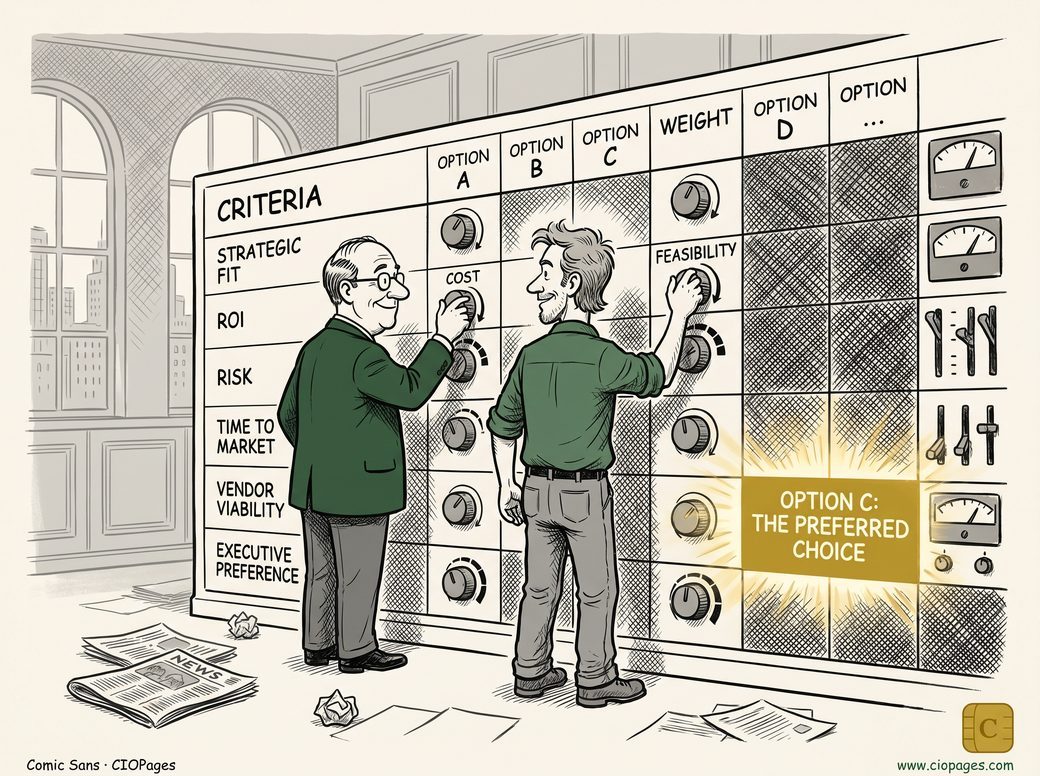
Adjust the weights until the matrix agrees with us. |
|
Verse Control
We weighted each factor with pride,
To three sig-figs, neatly applied.
The winner? But of course,
The one we'd endorse—
The math came along for the ride.
|
The Store · Digital products
Enterprise Business Capabilities Model
The definitive enterprise capability map with 1975+ capabilities spanning every major business function. A complete reference model for strategic planning, transformation, and technology alignment.
View in the store →
|
Share this issue
LinkedIn
X
Email |
Independent. No sponsorships. No affiliate revenue.
© 2026 CIOPages — A Capstera property. All rights reserved.
You are receiving The Throughline because you subscribed at ciopages.com.
Unsubscribe ·
Privacy · ciopages.com
|