|
Volume 01 · № 04 · August 1, 2026 |
|
The
Throughline
|
from CIOPages
|
An Independent Briefing for Technology Leaders |
This issue: planning for a future you can't predict. Why one confident forecast is a liability, and a handful of named scenarios is a strategy. |
The Big Read · the feature
Scenario Planning vs. Forecasting in Technology Strategy
A single three-year forecast is precise, confident, and almost always wrong. Here's why a small set of named scenarios beats one number — and how to get a board to value being roughly right over precisely wrong.
Read the full article on ciopages.com →
|
The Corner Office · a short take
Selling Uncertainty Upward
Boards ask for a single forecast because a range feels like you don't know your job. A confident point estimate reads as competence; “somewhere between eight and twenty-three weeks” reads as evasion. So leaders give the number they'll be punished least for — and then spend the next year explaining the variance. This is a teaching problem, not a forecasting one. Your job isn't to manufacture false certainty for an audience that prefers it. It's to make the board fluent in uncertainty — to help them see that a well-reasoned range is a stronger answer than a precise one that's wrong. That means showing your scenarios, naming your assumptions, and being explicit about what would change your mind. Done well, it shifts the board's expectation from “give me the number” to “show me the thinking.” The organisations that decide best aren't the ones with the most confident forecasts. They're the ones that learned to act intelligently without them. |
Decoded · in plain terms
Scenario Planning
Scenario planning is preparing for several plausible futures instead of betting everything on one forecast. The output isn't a number; it's a small set of named, internally consistent stories — “what if inference costs halve?”, “what if the vendor is acquired?” — and the moves each one would trigger. The point is robustness, not prediction. A single forecast is precise and almost always wrong; scenarios trade that false comfort for a plan that survives more than one version of reality. The mistake is treating scenarios as forecasts in disguise and quietly picking a favourite — which throws away the entire benefit. |
CIO Intelligence Suite · Software
Stop running build-vs-buy in a spreadsheet.
The CIO Intelligence Suite turns the calls you face — build vs. buy, cloud cost, modernization sequencing — into structured, defensible models you can take straight to the board.
Explore the apps →
|
|
Comic Sans
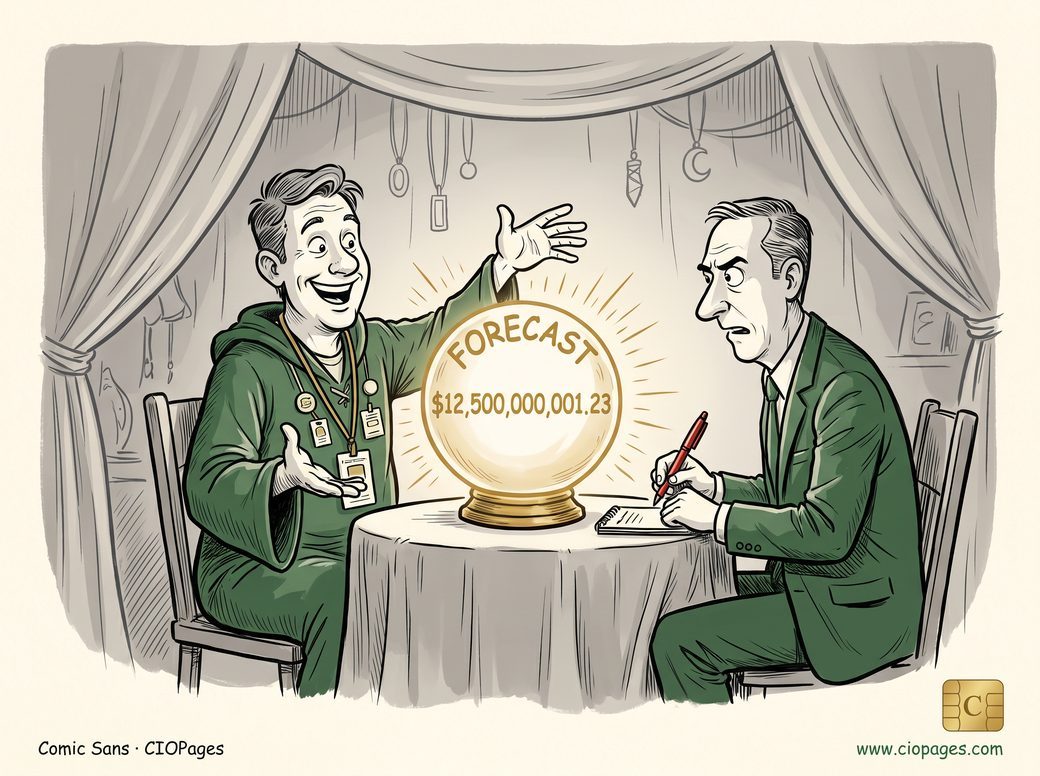
…and the confidence interval? |
|
Verse Control
We forecast the future, precise:
One curve, one assumption, the dice.
The slide was a beaut,
The line absolute—
Reality didn't think twice.
|
The Store · Digital products
Automotive Manufacturer Business Architecture Toolkit
A ready-to-use business architecture toolkit for Automotive Manufacturer — 340 capabilities, 27 value streams, and a complete data model. Skip months of discovery.
View in the store →
|
Share this issue
LinkedIn
X
Email |
Independent. No sponsorships. No affiliate revenue.
© 2026 CIOPages — A Capstera property. All rights reserved.
You are receiving The Throughline because you subscribed at ciopages.com.
Unsubscribe ·
Privacy · ciopages.com
|